Inspections and records
How often to inspect a hive, a frame-by-frame checklist, what to write down, and what to do next when you find a problem.
A regular inspection is how problems are caught while they are still small. This page covers how often to open a hive, a routine to follow on each frame, what to write down, and what to do about what you find. If you have never opened a hive, start with your first inspection, which covers smoke, handling and approach in detail.
How often to inspect
The Australian Honey Bee Industry Biosecurity Code of Practice sets a minimum: inspect each hive at least twice a year, with the inspections at least four calendar months apart. It also says inspections must be frequent enough to limit the spread of pests and disease between hives, and to avoid colony loss.
Twice a year is a minimum, not a target. BeeAware recommends inspecting several times a year, through spring, summer and autumn.
| Season | What the inspection is for |
|---|---|
| Spring | Confirm the queen is laying, check stores and space, watch for queen cells |
| Summer | Check space for honey, pests and brood health |
| Autumn | Thorough brood check and stores check before the colony settles for winter |
| Winter | Keep disturbance low; check from outside unless there is a reason to open the hive |
Timing varies with climate zone, so adjust it to your local seasons and ask your club (see clubs and associations).
What the Code requires at each inspection
- Look at the hive for general strength and for signs of pests and disease.
- Visually inspect at least the equivalent of three full-depth frames of brood, after shaking the adult bees off.
- In at least two inspections a year, test at least one hive in each apiary for external mites such as varroa, using a sugar shake, an alcohol wash or drone uncapping.
See varroa mite for how to run these tests, and note that state rules on testing frequency differ.
Routine on each frame
Work through the brood frames in order. Hold each frame over the box and look at both faces.
- Queen and eggs. You do not need to find the queen. Eggs and very young larvae show she was laying within the last few days.
- Brood pattern. Look for a solid block of brood with few empty cells. A patchy pattern is worth investigating.
- Brood appearance. Caps should be an even cream, tan or brown. Larvae should be pearly white and curled in the cell.
- Stores. Note how much honey and pollen the colony has.
- Space. Check the bees have room for the queen to lay and to store honey.
- Queen cells. Look on the faces and along the bottom edges of the combs.
- Disease signs. Sunken, dark, greasy or perforated cappings; off-colour or oddly positioned larvae; dark scales on the lower cell wall.
- Pests. Look for small hive beetle adults under the lid and in corners, wax moth damage, and mites on bees or brood.

What to write down
Write notes straight after closing the hive. A simple table is enough:
| Date | Hive | Weather | Strength | Brood and queen | Stores | Pests or disease | Action taken |
|---|---|---|---|---|---|---|---|
Record-keeping rules
The Code of Practice requires beekeepers to keep legible records of:
- apiary inspections: dates, observations, hive strength, any pests or diseases found and how they were detected
- actions taken to manage a pest or disease
- American foulbrood honey tests
- hive movements: dates, numbers and locations
- anything brought in from elsewhere (bees, used hives or hive parts), with date and supplier
- biosecurity training
Records can be on paper or electronic, and must be kept for at least three years. State rules can add to these, including how varroa tests are reported, so check your state department’s page (see registering your hives and state rules).
What to do about a problem
| You find | Next step |
|---|---|
| Sunken, perforated or greasy cappings, patchy brood | Stop and compare with the diagnosis guide. Suspected American foulbrood is notifiable: see foulbrood |
| Mites on bees, or a positive mite test | See varroa mite |
| Beetles or slimy honey | See small hive beetle |
| Webbing, tunnelled comb | See wax moth |
| Other brood problems | See other brood problems |
| Anything unusual you cannot identify | Contact your state department |
| Queen cells | Read swarm prevention |
| Low stores | See feeding, water and forage |
Only a laboratory test confirms a notifiable disease. A single odd cell is not a diagnosis, but it is reason to look again.
Photo credits
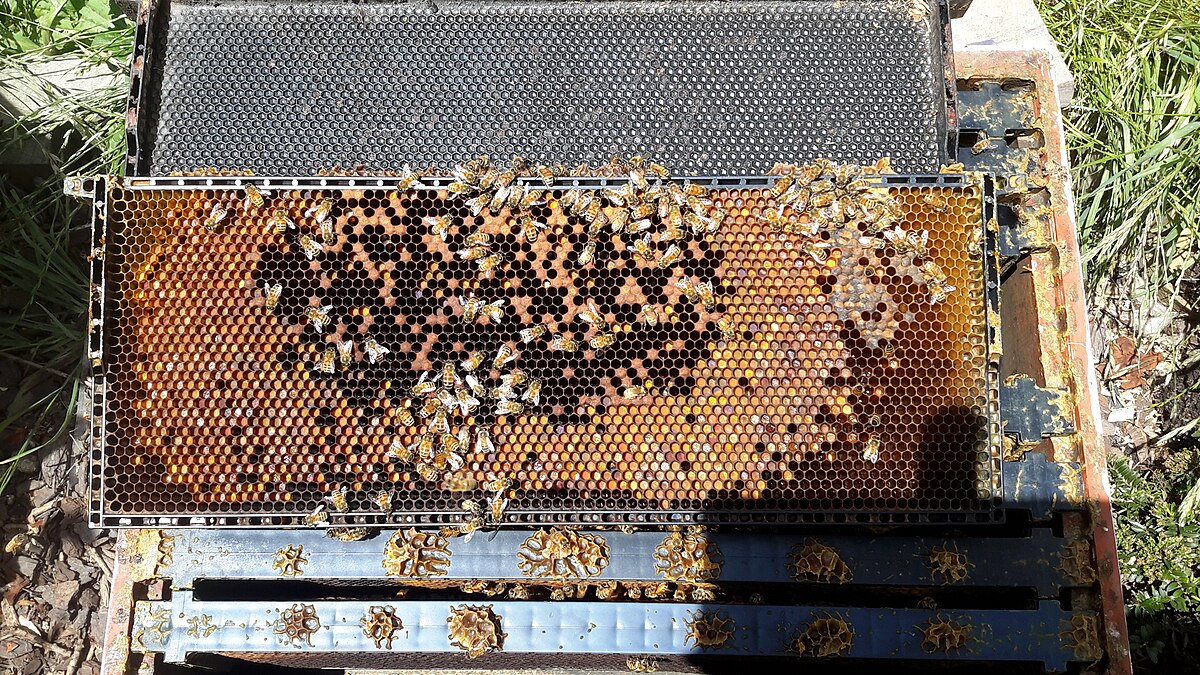
- Frame from a hive: John Pons, Wikimedia Commons, CC BY-SA 4.0.
Sources
Every fact on this page was checked against at least two independent sources.
- Inspecting hives (Code of Practice)BeeAware (Plant Health Australia)Official
- Record keeping (Code of Practice)BeeAware (Plant Health Australia)Official
- Hive inspectionsExtension Australia (Professional Beekeepers)Research and industry
- Inspecting hivesBeeAware (Plant Health Australia)Official