Swarm control and splits
How to spot a colony getting ready to swarm, how to give it room, how to make a simple split, and what to do about a swarm that has left.
Swarming is how a honey bee colony reproduces. The old queen leaves with roughly half the workers to set up a new home, and queen cells are left behind in the hive. For a beekeeper it means a lost queen, a much smaller colony and less honey. It is also the time when bees are most likely to upset neighbours.
Most swarm control comes down to three things: check regularly, give the bees room, and split a crowded colony yourself before it splits itself.
Check for signs of swarming
In Australia the risk is highest in spring, when colonies build up fast. Conditions can differ even within one valley, so go by what the bees are doing rather than the calendar. Look for:
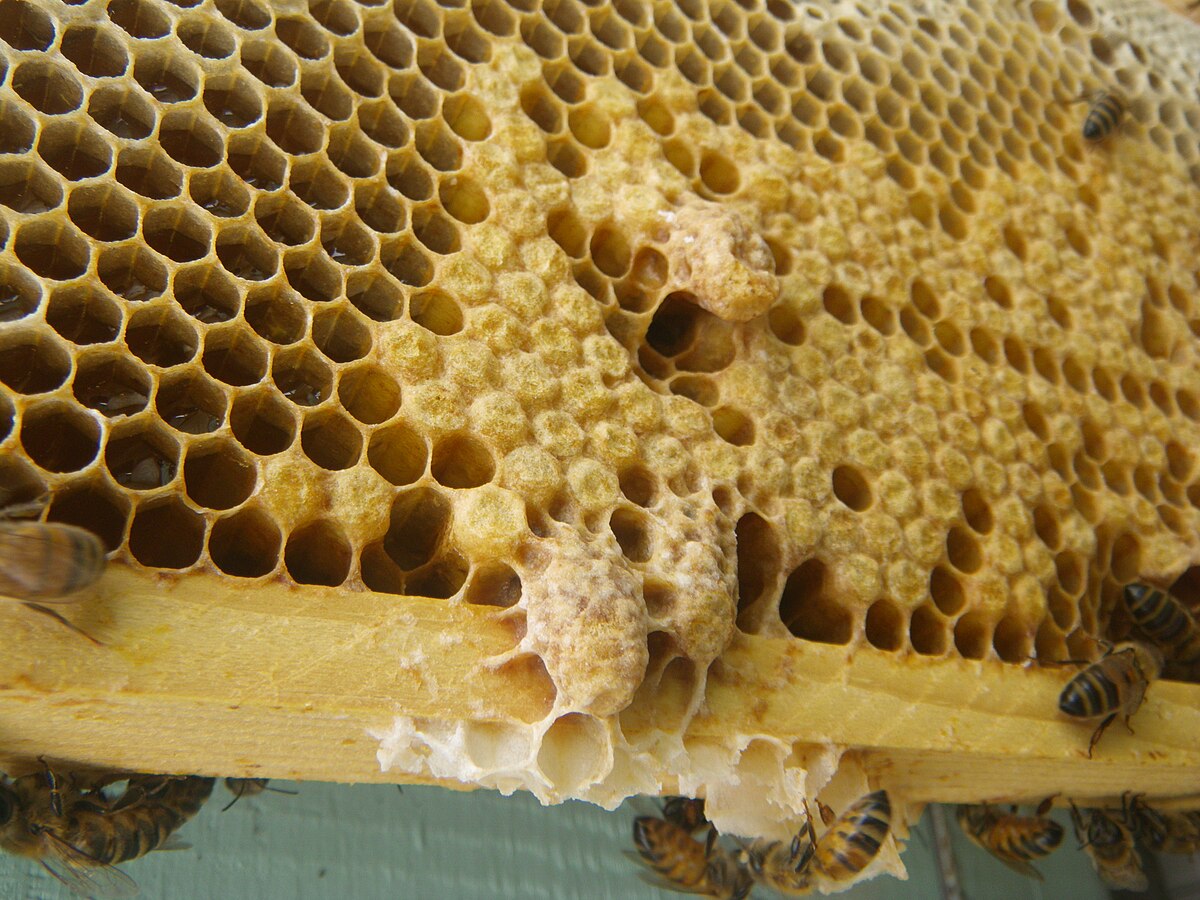
- Queen cells. Peanut-shaped cells hanging from the face or lower edge of the comb. Cells with an egg or young larva inside are a warning. Capped cells mean a swarm may be about to leave.
- Congestion. Every frame is full of bees, brood and nectar, with nowhere left for the queen to lay.
- A honey-bound brood nest. Nectar is stored in cells the queen would otherwise use.
- An older queen. Extension Australia lists replacing older queens as part of spring swarm management.
Look at the lower edges of frames by tilting them gently, as well as the faces. See inspections and records for how to run an inspection.

Prevent it: give room and keep queens young
During spring build-up, work through this list at each inspection:
- Add space before the bees need it. Add a super (honey box) if needed. Extension Australia notes that in a strong flow a super can fill very quickly, so check again soon.
- Do not let the colony become honey-bound. Extension Australia advises providing drawn comb rather than foundation where you can.
- Reduce congestion. This is part of Extension Australia’s early-spring swarm management list, alongside splitting hives.
- Replace older queens. See requeening and queen problems.
- Feed and forage. See feeding, water and forage.
Removing queen cells: what it can and cannot do
BeeAware lists giving extra space during build-up and removing queen cells as the way to control swarming. Cell removal only deals with the cells you find, so it works best alongside giving room and keeping queens young. If a colony already has capped queen cells, a split (below) is another option.
Make a split
Extension Australia lists splitting hives as an early-spring swarm control step. In a split, part of the colony (brood, bees and stores) is moved into a new box, so the colony has less crowding and a second queen can be raised or introduced.
A step-by-step walk-through of splitting was not confirmed by two sources for this page, so learn the method from your state department’s guide or an experienced beekeeper at your local club (see clubs and associations). A few points hold in any case:
- Treat the split as a new hive: register it if your state requires each hive or apiary to be registered, and check with your department if unsure.
- Inspect brood on all frames you move. Never move frames from a colony with signs of disease.
- A queenless split must raise a new queen, which then has to mate and start laying. A caged mated queen (see requeening) gets a split laying sooner.
If a swarm has left or landed
Bees in a swarm cluster usually have no home to defend and are generally quiet, but treat any swarm with care.
- Keep people, children and pets back. Do not throw things, hose or smoke the swarm.
- Swarms often move on within hours or days. If it is somewhere easy to reach, such as a low branch, an experienced beekeeper can collect it.
- If the swarm is in a hard-to-reach place or is a danger to the public, contact a local beekeeping club or call a beekeeper through your state beekeeping association. If there is a risk to public safety, call 000. See clubs and associations.
- If one of your own colonies swarms, check it for eggs after a few weeks to confirm there is a laying queen (see requeening).
Neighbours
Tell neighbours that you keep bees and how to contact you. A swarm that settles on a neighbour’s property is quickest to resolve if they already know who to call.
Swarms and biosecurity
A swarm may carry pests or diseases, so do not assume it is healthy. See varroa mite for mite testing.
- Keep a caught swarm in its own box, apart from your other hives, until you have inspected its brood and tested for mites.
- The Code of Practice requires records of hive movements, including swarm catch boxes (BeeAware).
- Register your new hives (including splits and caught swarms) where your state requires it. See registering your hives.
- Rules about moving or catching swarms can differ by state. Check with your state agriculture department before collecting swarms from other properties.
Swarm control checklist
- Inspect regularly through spring (see your state’s minimum in your first inspection).
- Look at the lower frame edges for queen cells.
- Add a super before the colony is crowded.
- Keep honey and brood balanced; don’t let the brood nest fill with nectar.
- Replace old queens.
- If capped queen cells are present, make a split.
- Record what you find (see inspections and records).
- Inspect and test any swarm you catch before combining it with other bees.
Photo credits
- Capped queen cells: shawn caza @ beekeeping.isgood.ca, Wikimedia Commons, CC BY-SA 3.0.
Sources
Every fact on this page was checked against at least two independent sources.
- Swarm management (keeping honey bees healthy)BeeAware (Plant Health Australia)Official
- Spring managementExtension Australia (Professional Beekeepers)Research and industry
- Record keeping (Code of Practice)BeeAware (Plant Health Australia)Official