Varroa mite
How to test your hives for varroa mite, which treatments are approved in Australia, how to use them, and what to report in your state.
Varroa mite (Varroa destructor) is a parasite of honey bees that spreads viruses and, left untreated, kills colonies. It is established in parts of New South Wales, Victoria, Queensland, South Australia and the ACT. It has not been found in Western Australia or Tasmania. This guide covers how to test for it, what to treat with, and what your state asks you to report.
Rules and approved products change often. This page is current as at October 2026. Check your state’s page (linked in the table below) before you act.
Part 1: Test your hives
What to look for
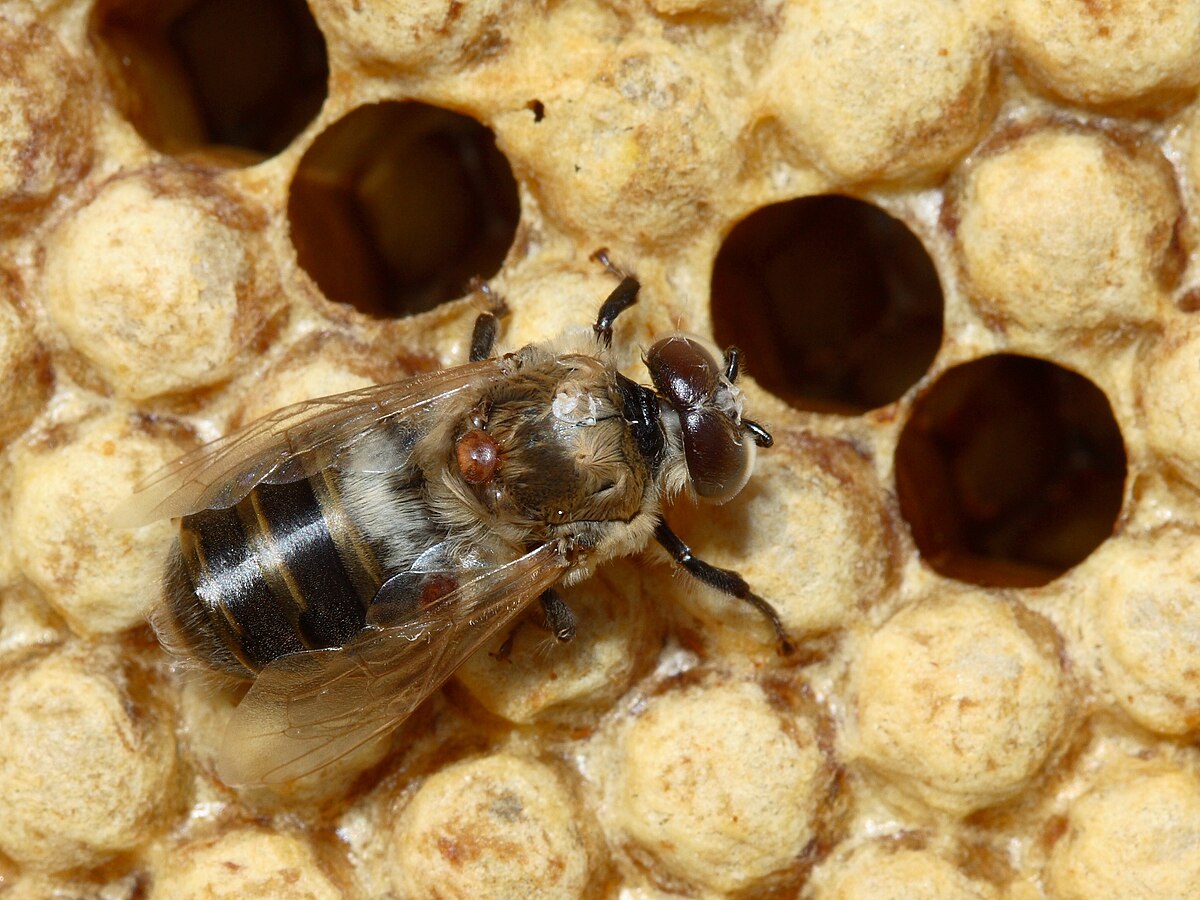
Adult female mites are oval, flat and reddish-brown. You can see them with the naked eye, but they are hard to spot on adult bees, so looking at the bees during an inspection is not a reliable check. Use one of the tests below instead.

Gear you need
- For an alcohol wash: a shaker jar with a mesh lid and a solid lid, methylated spirits or other alcohol over 70%, a tub to shake bees into, a half-cup measure, and a white tray or filter to catch the mites.
- For a sugar shake: a shaker jar with a mesh lid, icing sugar, and a white bucket or tray with some water in it.
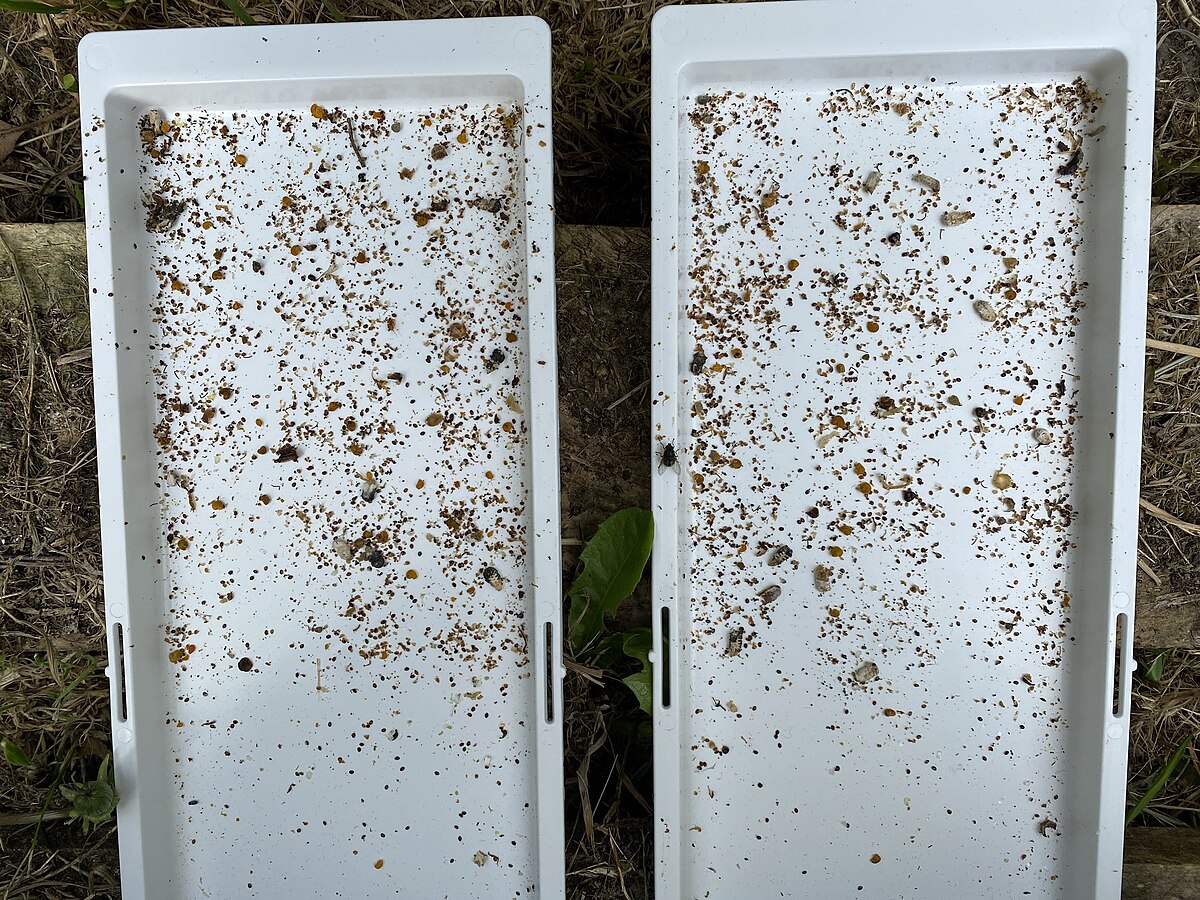
- For a sticky mat: a sticky mat (or a board coated with vegetable oil) that slides under a mesh (screened) bottom board.
- Your usual protective gear, smoker and hive tool. See Your first inspection.
Alcohol wash, step by step
The national program calls the alcohol wash best practice for varroa monitoring in Australia. It kills the sample of bees, but it gives the most dependable count.
- Pour alcohol into the jar.
- Open the hive and go down to the brood box.
- Take bees from the middle brood frames. Find the queen first and make sure she is not in your sample.
- Shake bees into the tub and scoop up half a cup, which is about 300 bees. Put them in the jar.
- Close the solid lid and shake the jar firmly.
- Swap to the mesh lid and pour the alcohol through it onto the white tray or filter. The bees stay in the jar and the mites wash out.
- Count the mites. Repeat the wash as your state’s guide describes to catch any that are left.
- Write down the count, the hive and the date.
Always use the same 300-bee (half-cup) sample, so you can compare results over time. Business Queensland has a written step-by-step guide, and NSW has videos of each method.
Sugar shake
The sugar shake uses the same 300-bee sample from the brood frames, but the bees go back to the hive afterwards.
- Put icing sugar in the jar, add the bees (no queen) and close it.
- Roll the jar gently so the bees are coated, then let it rest.
- Turn the jar upside down over the bucket and shake the sugar out through the mesh lid.
- The sugar dissolves in the water and the mites float, which makes them easier to count.
- Tip the bees back into the hive.
Sticky mat
A sticky mat under a mesh bottom board catches mites that fall from the colony. It shows whether mites are present. For a count you can compare with official advice, which is based on 300-bee samples, do an alcohol wash or sugar shake.

How often to test
| State | Official advice |
|---|---|
| NSW | Monthly, except in winter in very cold climates |
| Queensland | Monthly, and before, during and after treatment |
| Victoria | Four times a year, rising to every four weeks once varroa is established in your area |
| South Australia | Every three to four weeks if you are within 25 km of a detection |
If you have fewer than 10 hives in an apiary, test them all. With more than 10, test at least 10, including hives from the middle and the edges.
What the count means. The national program and NSW publish guide figures for when to plan and when to treat, by season. Both say the figures come from overseas and are still being worked out for Australia, so this guide doesn’t repeat them. Use the current table on NSW’s monitoring page, and ask your state’s bee biosecurity officers if you’re unsure.
Part 2: Treat and report
Approved treatments, by type
Use only products the APVMA has registered or allowed under a permit. Both kinds are listed below, as checked on the APVMA register on 31 October 2026. All are named by Business Queensland and NSW in their own varroa advice. A permit can limit who may use a product or in which states, so read it before you buy.
| Type | Product | Active ingredient | APVMA status |
|---|---|---|---|
| Synthetic strips (amitraz) | Apivar | Amitraz | Registered; also permit PER95905 |
| Synthetic strips (amitraz) | Apitraz | Amitraz | Permit PER95905 |
| Synthetic strips (pyrethroid) | Bayvarol | Flumethrin | Registered; also permit PER95037 |
| Organic acid | Formic Pro | Formic acid | Permit PER95344 |
| Organic acid | Api-Bioxal (solution and powder) | Oxalic acid | Permits PER94609 and PER96496 |
| Organic acid | Aluen CAP strips | Oxalic acid | Permit PER95790 |
| Thymol | Apiguard gel | Thymol | Registered |
The permit for Apistan, a pyrethroid strip, expired on 31 July 2026, and Apistan is not on the register, so it isn’t listed here. Some older state pages still name it.
Synthetic strips contain amitraz or a pyrethroid. Mites resistant to both pyrethroids and amitraz have been confirmed in NSW, Queensland, Victoria and South Australia, so in those states check that a strip treatment is working.
Organic acids and thymol are the non-synthetic options. They work differently from the strips, which makes them useful for rotating.
How to treat
- Test first. Treat only when your count says you need to, not on a timetable.
- Read the label or permit. It tells you the dose, where the product goes in the hive, how long it stays in, the temperatures it can be used in, and whether honey supers can stay on. Use the dose on the label.
- Use one product at a time. Never use two miticides together.
- Test during and after. Do an alcohol wash part-way through and after the treatment to see whether it worked.
- Rotate types. Don’t use the same type every time. Switch between amitraz, pyrethroids and the non-synthetic products to slow resistance.
- Keep records. Write down every chemical you use, the hive and the dates.
- Report a failure. If a treatment doesn’t bring mite numbers down, contact your state department.
Chemicals work best as part of a wider plan. Outbreak.gov.au and NSW both say to combine them with mechanical and cultural controls and to manage swarms. The NSW Varroa Management Tool suggests options to suit your hives and the season.
What to report, state by state
Every beekeeper also has a general duty under state law to manage biosecurity risks. NSW calls it the general biosecurity duty, and Queensland calls it the general biosecurity obligation.
| State | Can you treat? | What you must report | Who to contact |
|---|---|---|---|
| NSW | Yes, with approved products | Your first positive detection | Report a Biosecurity Concern form; bee.biosecurity@dpird.nsw.gov.au |
| Victoria | Yes, with approved products | A positive detection, immediately | Varroa inspection event in your BeeMAX diary |
| Queensland | Yes, with approved products | Varroa is restricted matter: report, control or contain it. Record every check on the Bee 123 form, even with no mites | Business Queensland; varroa@dpi.qld.gov.au |
| South Australia | Yes, with approved products | Positive tests | PIRSA by email |
| ACT | Yes, with approved products | Nothing. Varroa is no longer notifiable in the ACT (since 5 June 2026), but you must still register your hives | ACT Biosecurity, for help |
| Western Australia | Not found here. Report first and follow instructions | Any suspicion. Varroa is a prohibited organism | DPIRD |
| Tasmania | Not found here. Report first and follow instructions | Any suspicion. Varroa is notifiable | Biosecurity Tasmania |
Don’t post a sample unless the department asks, and Biosecurity Tasmania asks you not to take live mites away from the apiary.
Slowing the spread
Mites move between hives on drifting bees, swarms, shared equipment and hives moved between apiaries. Control swarms and don’t share equipment between apiaries. The national Biosecurity Code of Practice was revised in late 2025, and Part C now applies from 20 hives. See Registering your hives.
Local clubs often run varroa workshops. See Clubs and associations.
Photo credits
- Varroa mites on a drone bee: Waugsberg, Wikimedia Commons, CC BY-SA 3.0.
- Mite drop trays: Einebillion, Wikimedia Commons, CC BY 4.0.
Sources
Every fact on this page was checked against at least two independent sources.
- Check your hives for varroa miteBusiness QueenslandOfficial
- Manage varroa miteBusiness QueenslandOfficial
- Monitor for Varroa miteNSW Department of Primary Industries and Regional DevelopmentOfficial
- Varroa mite managementNSW Department of Primary Industries and Regional DevelopmentOfficial
- Agricultural and veterinary permits search (varroa)Australian Pesticides and Veterinary Medicines Authority (APVMA)Official
- Public Chemical Registration Information System (PubCRIS)Australian Pesticides and Veterinary Medicines Authority (APVMA)Official
- MonitoringNational Varroa Mite Management ProgramOfficial
- Chemical control optionsNational Varroa Mite Management ProgramOfficial
- Varroa mite (Varroa destructor)Outbreak.gov.auOfficial
- Varroa mitesBeeAware (Plant Health Australia)Official
- Varroa mite - frequently asked questionsAgriculture VictoriaOfficial
- Varroa mitePrimary Industries and Regions SA (PIRSA)Official
- Varroa miteBiosecurity Tasmania (NRE Tas)Official
- Varroa miteWA Department of Primary Industries and Regional DevelopmentOfficial
- Varroa miteACT GovernmentOfficial
- Biosecurity (Notifiable and Prohibited Biosecurity Matter) Declaration 2026 (NI2026-262)ACT Legislation RegisterOfficial
- AHBIC Biosecurity Update – Resistant Varroa Mite – 10 April 2026Australian Honey Bee Industry CouncilResearch and industry